

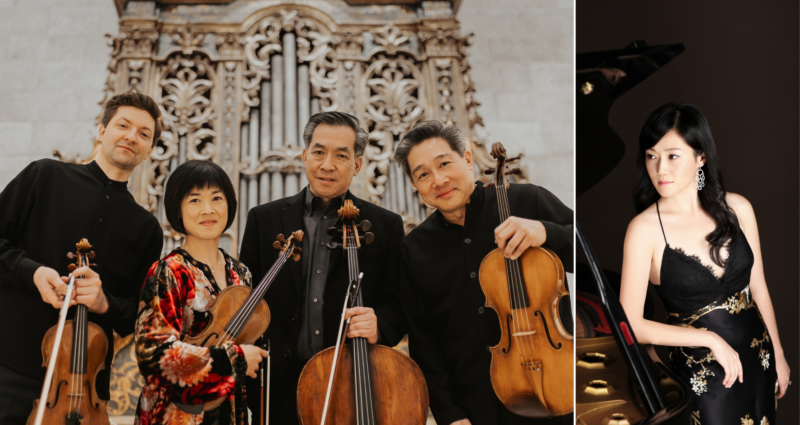
Music at the Mill: Ying Quartet with Jeewon Park
Join us at Dutchman’s in Brunswick for our spring Music at the Mill Concert. The evening includes a wine and beer social hour, chamber music concert, and gourmet pizza reception. The performance features the Ying Quartet teaming up with pianist Jeewon Park for Brahms’ beloved Piano Quintet.
Ying Quartet
Robin Scott, Janet Ying, violin • Phillip Ying, viola • David Ying, cello
JOHANNES BRAHMS
Piano Quintet in F Minor, Op. 34
Robin Scott, Janet Ying, violin • Phillip Ying, viola • David Ying, cello • Jeewon Park, piano
Additional repertoire to be announced.
6:00 PM: Doors and Bar Open
Join us for beer and wine before the concert.
7:00 PM: Concert
8:15 PM: Post-Concert Reception
Join us in the restaurant after the concert for delicious pizza and to chat with the artists. Pizza, beer, and wine are included with your ticket purchase.
Program Notes
JOHANNES BRAHMS
Piano Quintet in F Minor, Op. 34 (1864)
Brahms’ Piano Quintet belongs to an outpouring of chamber music from the early 1860s — the period musicologists generally call Brahms’ “first maturity” — which also gave rise to his two string sextets, his first two piano quartets, and the horn trio. The style Brahms cultivated during these years is partly accountable to his historicist sensibility: his appreciation for the large-scale formal arcs and emotional intensity of Beethoven, to be sure, but also his study of the unhurried melodies and harmonic sorcery of Schubert, whose instrumental music was considerably less known at that time.
But the final form of the Piano Quintet is also the result of Brahms’ dialogue with a trusted coterie of performers who offered critical feedback. The musical substance began its life scored for string quintet, with two cellos (suggesting that Brahms was keeping the score of Schubert’s glorious cello quintet nearby). He presented this version of the work to violinist Joseph Joachim, a close friend and tireless advocate of Brahms’ work. After rehearsing the work with colleagues, Joachim disclosed his misgivings to Brahms: “every line shows proof of an almost overwhelming creative strength, full of spirit through and through.” But, Joachim continued, “the instrumentation is not energetic enough to my ears to convey the powerful rhythmic convulsions; the sound is almost helplessly thin for the musical thought. Then again for long stretches everything lies too thickly. You surely can’t like it either: it sounds artificial!” After some unsatisfactory attempts to salvage the work as a string quintet, Brahms (always the perfectionist) burned the score, and decided to rearrange the work as a Sonata for Two Pianos. It was in this form that Op. 34 received its premiere in 1864, Brahms playing with Karl Tausig, a student of Liszt. But when Brahms shared this version with Clara Schumann, his confidante betrayed her own doubts: “The first time I played it I had the impression it was an arrangement. It cannot be called a sonata; rather, it is a work whose ideas you could — and should — distribute among the whole orchestra, as though out of a horn of plenty!” Perhaps it is fitting, then, that Brahms ultimately found the perfect compromise in the Piano Quintet formation — something of a hybrid, preserving the best elements of both previous ventures — a genre which had been pioneered by Robert Schumann two decades prior. Unlike the string quintet, however, Brahms did not destroy the two-piano version, which continues to enjoy occasional performance to this day.
Program Note by Peter Asimov
MILL SERIES SPONSORS


