

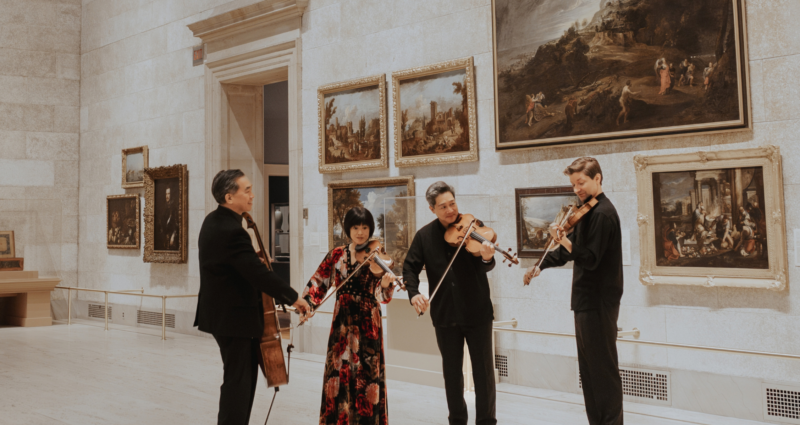
Music at the Mill: Ying Quartet
Join us at Dutchman’s in Brunswick for our fall Music at the Mill Concert. The evening includes a wine and beer social hour, chamber music concert, and gourmet pizza reception.
Ying Quartet
Robin Scott, Janet Ying, violin • Phillip Ying, viola • David Ying, cello
WOLFGANG AMADEUS MOZART (1756–1791)
String Quartet No. 19 in C Major, K. 465, “Dissonance”
JOHANNES BRAHMS (1833–1897)
String Quartet No. 1 in C Minor, Op. 51, No. 1
6:00 PM: Doors and Bar Open
Join us for beer and wine before the concert.
7:00 PM: Concert
8:15 PM: Post-Concert Reception
Join us in the restaurant after the concert for delicious pizza and to chat with the artists. Pizza, beer, and wine are included with your ticket purchase.
Program Notes
WOLFGANG AMADEUS MOZART
String Quartet No. 19 in C Major, K. 465, “Dissonance” (1785)
This curious piece, composed by Mozart shortly after he settled in Vienna, belongs to a set of six quartets dedicated to Haydn and known collectively as the “Haydn Quartets.” Mozart drew inspiration from that elder statesman of the string quartet, who continued to set the bar for the genre with his own set of six quartets, Op. 33. Mozart pored over these works, assimilating Haydn’s consummate craftsmanship while adapting the genre to his own voice; if Mozart is famed for the ease and spontaneity with which he effused musical ideas, this batch of quartets represented, in the composer’s words, “the fruits of a long and laborious endeavor” — a testament to his earnestness in preparing to offer his work to Haydn.
Few bars of music have provoked as contentious a response as the “dissonant” opening bars of K. 465. Over the cello’s pulsating C, the upper instruments enter one by one — first the viola drones an A-flat; then the second violin, an E-flat; then the first violin, an A-natural, at which point the viola slips down to G — resulting in a distended half-diminished sonority and, three bars of gnarled counterpoint later, a resolution to the distant key of B-flat Minor, whereupon the sequence repeats itself.
The reaction of nineteenth-century Belgian musicologist François-Joseph Fétis to Mozart’s opening gambit was not unusual, and set the tone for years to come. Writing in 1829, Fétis lauded the quartet as a “masterpiece,” but singled out the “bizarre” introduction that “tests artists’ nerves,” in which Mozart “took pleasure in torturing a delicate ear” — or else was the victim of “some ignorant copyist.” Fétis rewrote the idiosyncratic introduction according to rules set out in his own counterpoint treatise, ironing out the “offending” dissonance. Yet sure enough, when Fétis later encountered the original manuscript on a trip to London, he found, to his stupefaction, that “the passage, so often criticized, was written by Mozart without any crossing-out; the inconceivable, pointless dissonances, which shred the ear, are there, notated in his own hand.” Fétis’ testimony did not prevent future critics and editors from proposing their own “repairs” to Mozart’s work — including six alternative introductions proposed in 1832 by Gottfried Weber — and even when interpreting Mozart’s opening as written, performers must choose whether to try to smooth over, or lean into, these taut sonorities.
Yet, attention to these enigmatic bars of introduction risks overshadowing the effusive joy and mastery of craft that reigns over the rest of the quartet — the qualities that led, in the months following Mozart’s dedication of the set, to Haydn’s famous remark to Amadeus’ father, Leopold: “Before God and as an honest man I tell you that your son is the greatest composer known to me either in person or by name.”
Program Note by Peter Asimov
JOHANNES BRAHMS
String Quartet No. 1 in C Minor, Op. 51, No. 1 (1865–1873)
Johannes Brahms took a while to complete his first two string quartets. According to Max Kalbeck’s early biography of the composer, he threw out over twenty initial attempts. This may be apocryphal — the number might have been lower — but his perfectionism with this genre was quite real. He was hesitant to contribute to the symphonic and string quartet literatures in part because he felt “the tramp of a giant” behind him, referring to the expectation that he follow in Beethoven’s footsteps. In 1865, Brahms mentioned in letters that he was working on a String Quartet in C Minor. But it took him eight more years to finish this piece and the Quartet in A Minor, with which he paired it for release as his Op. 51. In correspondence with his publisher, he excused the delay by comparing himself (in a self-effacing manner) to Mozart, who “made a very special effort to write six beautiful quartets, so we must certainly exert ourselves a bit to make one or the other [of my quartets] tolerable.”
A reviewer in Vienna admitted being slightly overwhelmed when he first heard the results of Brahms’s exertion, maintaining that the C Minor Quartet was “a deeply serious composition which will receive its due appreciation only after repeated performance.” The opening and closing movements are built from very short melodic fragments, which have a thrilling, explosive energy but rarely combine into anything plainly singable or tuneful. Another contemporary reviewer, Hermann Dieters, recognized in this approach an intentional continuity with the late quartets of Beethoven. Decades later, Arnold Schoenberg described Brahms’s writing in his Op. 51 Quartets as “progressive,” claiming it (somewhat anachronistically) as a precursor to the developmental splinters typical of modernism, and specifically atonal and twelve-tone music.
The charming, odd third movement of the C Minor Quartet is highly characteristic of Brahms’s mature style. In place of a theatrical, accent-filled scherzo, he writes an Allegretto molto moderato e comodo (to be played comfortably and in a moderate tempo). The long, lazy chromatic line in the violin (marked semplice or “simple”) sways along, taking its time. The music is subtly playful but also incredibly patient, reveling in the caprice and pathos of single intervals and of little moments of interaction among the different voices of the quartet.
Program Note by Nicky Swett
MILL SERIES SPONSORS


