

- This event has passed.
Schubert, Ogonek, & Bartók
FRANZ SCHUBERT
String Trio in B-flat Major, D. 581
Renée Jolles, violin • Melissa Reardon, viola • David Ying, cello
ELIZABETH OGONEK
Running at Still Life
Dōnum Quartet: Inhae Cho, Seungwon Park, violin • Ilgyeong Shin, viola • Hyeonmin Lee, cello
BÉLA BARTÓK [ARR. SKELTON]
Concerto for Orchestra, Arranged for Two Pianos (world premiere)
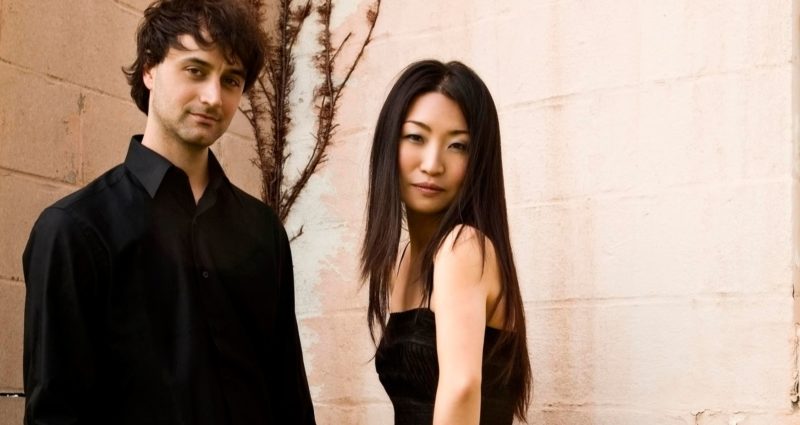
Ran Dank, Soyeon Kate Lee, piano
—
Program Notes
FRANZ SCHUBERT (1797–1828)
String Trio in B-flat Major, D. 581
String trios are a challenging, exposed medium for composers and players alike. Ludwig van Beethoven was relatively comfortable with it. He wrote and published several such works as a kind of warm-up for producing his first set of string quartets, which seemed to him the more daunting genre. For Franz Schubert, this dynamic was the opposite. He composed his first quartet as a young teenager and by the age of 20 he had completed 11 of them, yet he struggled to complete a single string trio. He started one in 1814, but he quickly elected to turn it into a quartet. He tried again in 1816 and got a bit further, completing an Allegro and a chunk of an Andante sostenuto. Schubert finally managed to finish a full, four-movement String Trio in B-flat major, D. 581, in 1817. But even then, he left the piece in two versions, hinting at the difficulty he had in arriving at a definitive work for these instruments.
In the serene opening Allegro Moderato of the D. 581 Trio, Schubert spends a good deal of time lulling us into a sense of comfort. Then, in the middle of the movement, he writes a bold, striking modulation to F-sharp minor, where the bass drops and the cello’s urgent, leaping line supports a rhapsodic break in the violin. The Andante features a subtly powerful, Minor-key, viola-centric passage, and in the central trio section of the Menuetto, Schubert gives the viola a cheeky solo full of surprising accents. As in many of his later works, he closes the piece with a generally jolly rondo that has a few special moments of sudden seriousness and depth. Schubert was a masterful composer of patient music. The first violin occasionally engages in rapid, fluttering figuration, but even when the fingers are moving fast, he lets the other musical elements unfold at a leisurely pace, creating an otherworldly sense of space and time.
ELIZABETH OGONEK (b. 1989)
Running at Still Life
Elizabeth Ogonek’s Running at Still Life for String Quartet, which was commissioned by the Sante Fe Chamber Music Festival in 2013, is full of dramatic changes in character. As she puts it in a description of the piece she included in her doctoral dissertation, “I set out to determine the parameters needed to delineate musical narrative if there was no perceivable program. The music was not to represent images or events but to suggest a narrative undercurrent.”
The work unfolds in nine, short sections — “major events,” as she describes them — that are separated in the score by thick barlines. Ogonek forms clear oppositions throughout: between melodic figures that contain a grinding major second and moments of perfect unison; between violent gestures and atmospheres of calm and stasis; and between gruff, crunchy chords and appealing, tonal tunes like the one played by the cello in a reverie in the middle of the piece. Infectious, rhythmically active passages suddenly come to a halt, and plaintive melodies are often cut off by angry clusters of notes. These divergences produce a state of regular interruption that develops its own kind of narrative logic. At the end of the quartet, the musicians appear to have come together for a rare moment of rhythmic and tonal unison. But after a pause, the first violin floats up on a whimsical, ethereal, closing figure that, in Ogonek’s words, “attempts to free the piece from an obligation to resolve those tensions that pervade the music.”
— Intermission —
BÉLA BARTÓK (1881–1945) [ARR. SKELTON]
Concerto for Orchestra, Arranged for Two Pianos (world premiere)
In the spring of 1943, Béla Bartók had stopped composing, he and his family had run out of money, and he was enduring a long hospital stay for leukemia treatment. To help him out, his friends Joseph Szigeti and Fritz Reiner landed him a commission from Sergei Koussevitsky and the Boston Symphony for a new orchestral piece. Their scheme worked; in a letter of thanks to Szigeti, Bartók’s wife Ditta described how her husband had regained strength and enthusiasm for his work: “Plans, musical ambitions, compositions are stirring in Béla’s mind… One thing is sure: Béla’s ‘under no circumstances will I ever write any new work’ attitude has gone.” He finished the concerto in October of 1943 and when it premiered in December of the next year, it made an immediate splash with reviewers and audiences alike.
Bartók called the piece a Concerto for Orchestra because he gives solo turns to individual members of the ensemble throughout the work. This feature is most obvious in the second movement, when pairs of wind instruments play distinct melodies two by two as if being presented at a ball. Such timbral schemes are nearly impossible to reproduce in keyboard transcriptions of the piece such as the two-piano arrangement by Logan Skelton that sees its world premiere on this program. But this chamber music setting has the unique capacity to highlight other meaningful elements in the music that tend to get lost in the electrifying anarchy of orchestral performance. Bartók constantly mixes meters, uses angular and asymmetrical subdivisions, and layers entries of assorted voices in raucous contrapuntal arrays. The piano’s percussive precision foregrounds all of this catchy, rhythmic variety. Bartók also uses carefully-designed thematic links across the five movements of the piece to unify it in the manner of a symphony, but he disguises these connections well enough in the diverse tone colors of the orchestra that many early critics missed their presence and significance. These relationships shine through in a thrilling manner in this transcription, which somewhat ironically has the potential to bring out the Concerto for Orchestra’s monumental, symphonic side.
Program Notes by Nicky Swett