

- This event has passed.
SOLD Out — JOIN THE WAITLIST
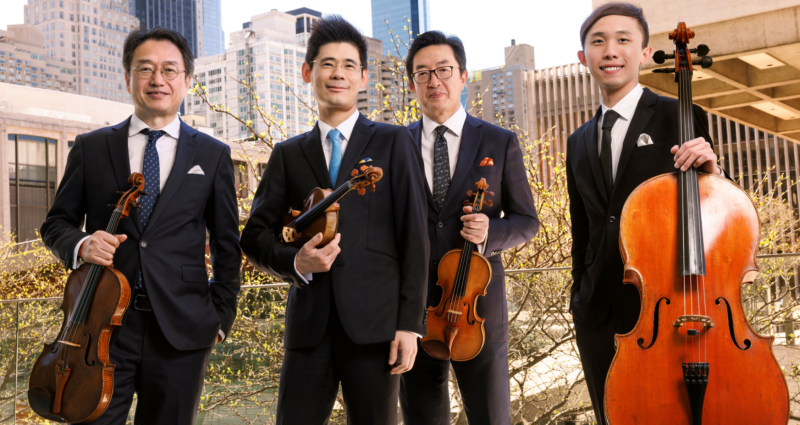
Shanghai Quartet
Shanghai Quartet
Weigang Li, Angelo Xiang Yu, violin • Honggang Li, viola • Sihao He, cello
FRANZ JOSEPH HAYDN (1732–1809)
String Quartet in G Minor, Op. 74, No. 3, Hob. III:74, “The Rider”
ZHOU LONG (b. 1953)
Chinese Folk Songs
ANTONÍN DVOŘÁK (1841–1904)
String Quartet No. 12 in F Major, Op. 96, “American”
Program Notes
FRANZ JOSEPH HAYDN
String Quartet in G Minor, Op. 74, No. 3, Hob. III:74, “The Rider” (1793)
In November 1790, Joseph Haydn’s primary patron and employer, Prince Nikolaus Esterházy, died. Esterházy’s son Anton scaled back the musical establishment at the palace of Eisenstadt, where Haydn had lived and worked since the early 1760s, and the composer made quick arrangements to move to Vienna. The change of circumstances was a mixed blessing. He lost a large chunk of his salary and duties, but he continued to receive an annual stipend from the Esterházys. Though he was occasionally called back to court, he gained a degree of professional freedom he hadn’t experienced in decades. This newfound autonomy, combined with some lucrative and stimulating opportunities in London secured by the impresario Johann Peter Salomon, helped to spur a remarkable wave of creativity. In the 1790s, Haydn produced a slew of symphonies, chamber music, and vocal works that displayed fresh approaches to rhythm, orchestration, and form.
He wrote his Op. 71 and Op. 74 Quartets — six quartets in all — in Vienna in 1793, anticipating his second visit to London. The final quartet in the collection, Op. 74, No. 3, in G Minor, was posthumously assigned the nickname of “The Rider” or “The Horseman,” presumably because of the urgent, precipitous syncopations of the finale. In a formally daring move, Haydn sets the slow movement in the key of E Major, a covered and fragile tonality on string instruments that is quite remote from the key of G, which serves as home base in the rest of the piece. One delightful quirk of the work is found in the first measures of the opening Allegro. The Quartet, playing in unison, climbs up an arpeggio on repeated notes that are embellished by chirping grace notes. Though these ornamental grace notes appear again in the movement’s development section, the gesture never reoccurs as we hear it at the start; it is like a gruff throat clearing that Haydn uses to grab our attention before proceeding to say what he had planned to say.
ZHOU LONG
Chinese Folk Songs (1998)
In his music, Chinese-American composer Zhou Long strives to combine “Ancient Chinese musical traditions and Western compositional techniques into a coherent and personal statement.” He made these string quartet arrangements of Chinese folk songs for a 1998 album of the Shanghai Quartet. In his liner note for the disc, he explains how “In China, folk music and songs have traditionally crisscrossed the clearly distinguished boundaries between high and low culture.” He lays out three types of songs he included in his collection: “Shan’ge, or mountain songs, are sung in the open air, often with long trills that can carry over great distances; Haozi, or working songs, are simple tunes with strong rhythms sung by workmen to accompany their labor; and Xiao Diao, more structured and sophisticated, are arranged and performed by professional or semi-professional musicians for entertainment.”
Zhou Long’s transcriptions are quite diverse in their technical and expressive treatments of the material. The collection opens with Lan hua hua, a lush setting of a song that depicts “a country girl who escapes from a forced marriage to a rich family.” In Driving the mule team, he creates a buzzy, popping groove. One player strums arpeggios while other musicians have syncopated trills, chords, and sustained notes that bounce off the top of the plucked figure. The sweet longing of The flowing stream contrasts with the jaunty dissonances in this rendition of Jasmine flower, in which the hesitant speaker wants to pluck a beautiful flower but is worried about things like “gossips” and “the garden’s keeper.” In the rollicking Horseherd’s mountain song, the string quartet whoops along with their own raucous, energetic playing. In the sixth piece in the collection, rhythmic freedom and textural diversity underscore the listlessness of a young woman who “awaits her lover under the acacia tree.” The catchy penultimate number, A single bamboo can easily bend, sets the stage for Leaving home, a somber, impressionistic finale in which “a wife bids farewell to her husband, who is going westward to seek livelihood.”
Program Notes by Nicky Swett
ANTONÍN DVOŘÁK
String Quartet No. 12 in F Major, Op. 96, “American” (1893)
Over the 1880s, Dvořák experienced a meteoric rise in worldwide fame. He visited England nine times, and also toured Russia; official recognition came in the form of an honorary degree from the University of Cambridge in 1891 and his appointment as professor of composition at the Prague Conservatory. And yet, despite this stable, even comfortable, station, Dvořák could not resist an offer from the United States to take up the directorship of the National Conservatory of Music — a federally funded institution newly opened just north of Union Square in New York City. Dvořák, his wife, and two of their children set off from the port of Bremen in September 1892, arriving to Hoboken, New Jersey, after nine days aboard the SS Saale.
Dvořák made the most of his three years in America, artistically and pedagogically. He became enamored of musical cultures new to him, particularly African American spirituals he heard in New York, and the most likely Sioux and Lakota musics he heard during a sojourn in the midwest. Dvořák’s attitude toward these musics — that they were direct manifestations of the souls of a people — reflected Romantic, racialised views popular among nineteenth-century intellectuals, which paralleled his views regarding the folk musical cultures of Eastern Europe. On the other hand, as director of the National Conservatory, Dvořák demanded that the institution accept African American students, free of tuition, convinced that they belonged at the heart of America’s musical culture.
It was during that productive three-month sojourn in the midwest — in Spillville, Iowa, in the summer of 1893 — that Dvořák composed his famous “American” String Quartet, Op. 96, as well as the Symphony No. 9, “From the New World,” and his String Quintet No. 3, Op. 97. The so-called “Czech Village” (population ca. 350, then as now), founded in 1860 along the banks of the Turkey River, was the birthplace of Dvořák’s secretary, the violinist Josef Jan Kovařik, who had met Dvořák in Prague and followed him to New York. When Kovařik invited Dvořák and his family to his hometown, Dvořák seized the opportunity to see another part of the United States as well as to connect with his diasporic community.
Despite the moniker, the question of whether the quartet contains quotations of genuinely “American” musical materials has inspired debate, but little consensus. The most conclusively identified borrowing in the work comes not from the fellow humans in Dvořák’s American surroundings, but from nature: a snippet of birdsong — that of a scarlet tanager, or perhaps a red-eyed vireo — transcribed by Dvořák during his morning walks along the riverbank chirped its way into the first violin part, capping off the opening phrases of the Scherzo.
Program Note by Peter Asimov
—
Over the past 40 years, the Shanghai Quartet has become one of the world’s foremost chamber ensembles. The Shanghai’s elegant style, impressive technique, and emotional breadth allows the group to move seamlessly between masterpieces of Western music, traditional Chinese folk music, and cutting-edge contemporary works. Formed at the Shanghai Conservatory in 1983, soon after the end of China’s harrowing Cultural Revolution, the group came to the United States to complete its studies; since then the members have been based in the U.S. while maintaining a robust touring schedule at leading chamber-music series throughout North America, Europe, and Asia.
Recent performance highlights include performances at Carnegie Hall, the Metropolitan Museum of Art, the Freer Gallery (Washington, D.C.), and the Festival Pablo Casals in France, and Beethoven cycles for the Brevard Music Center, the Beethoven Festival in Poland, and throughout China. The Quartet also frequently performs at Wigmore Hall, the Budapest Spring Festival, Suntory Hall, and has collaborations with the NCPA and Shanghai Symphony Orchestras. Upcoming highlights include the premiere of a new work by Marcos Balter for the Quartet and countertenor Anthony Roth Costanzo for the Phillips Collection, return performances for Maverick Concerts and the Taos School of Music, and engagements in Los Angeles, Syracuse, Albuquerque, and Salt Lake City.
Among innumberable collaborations with eminent artists, they have performed with the Tokyo, Juilliard, and Guarneri Quartets; cellists Yo-Yo Ma and Lynn Harrell; pianists Menahem Pressler, Peter Serkin, Jean-Yves Thibaudet, and Yuja Wang; pipa virtuoso Wu Man; and the vocal ensemble Chanticleer. The Shanghai Quartet appears regularly at many of North America’s most prominent chamber-music festival, including annual performances for Maverick Concerts, the Brevard Music Center, and Music Mountain.
The Shanghai Quartet has a long history of championing new music, with a special interest in works that juxtapose the traditions of Eastern and Western music. The Quartet has commissioned works from an encyclopedic list of the most important composers of our time, including William Bolcom, Sebastian Currier, David Del Tredici, Tan Dun, Vivian Fung, Lowell Lieberman, Zhou Long, Marc Neikrug, Krzysztof Penderecki, Bright Sheng, Chen Yi, and Du Yun. The Quartet had a particularly close relationship with Krzysztof Penderecki; they premiered his third quartet – Leaves From an Unwritten Diary – at the composer’s 75th birthday concert and repeated it again at both his 80th and 85th birthday celebrations. Forthcoming and recent commissions include new works from Judith Weir, Tan Dun, and Wang Lei, in addition to a new work from Penderecki.
The Shanghai Quartet has an extensive discography of more than thirty recordings, ranging from Schumann and Dvorak Piano Quintets with Rudolf Buchbinder to Zhou Long’s Poems from Tang for string quartet and orchestra with the Singapore Symphony. The Quartet has recorded the complete Beethoven string quartets and is currently recording the complete Bartók quartets.
A diverse array of media projects run the gamut from a cameo appearance playing Bartók’s String Quartet No. 4 in Woody Allen’s film “Melinda and Melinda” to PBS television’s “Great Performances” series. Violinist Weigang Li appeared in the documentary From “Mao to Mozart: Isaac Stern in China”, and the family of cellist Nicholas Tzavaras was the subject of the film “Music of the Heart,” starring Meryl Streep.
Serving as Quartet-in-Residence at the John J. Cali School of Music at Montclair State University since 2002, the Shanghai Quartet joined The Tianjin (China) Juilliard School in fall 2020 as resident faculty members. The Quartet also is the Ensemble-in-Residence with the Shanghai Symphony Orchestra and visiting guest professors of the Shanghai Conservatory and Central Conservatory in Beijing. They are proudly sponsored by Thomastik-Infeld Strings and BAM Cases.