

- This event has passed.
SOLD OUT — JOIN THE WAITLIST
Bach, Beethoven & Mendelssohn
JOHANN SEBASTIAN BACH (1685–1750)
Sonata in G Minor, BWV 1020
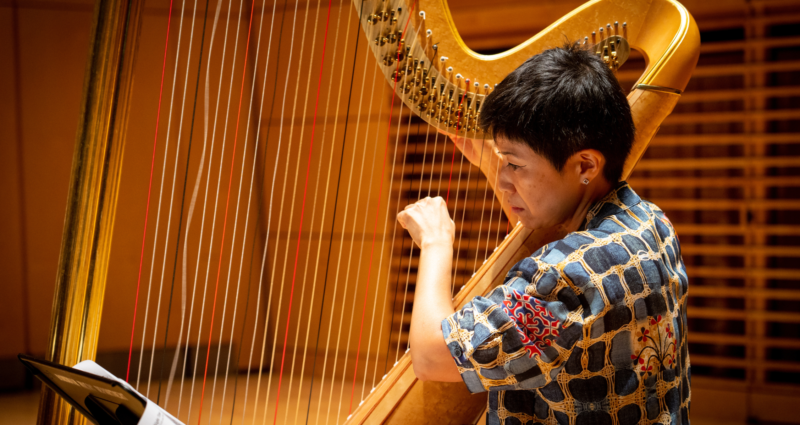
Meg Freivogel, violin • June Han, harp
LUDWIG VAN BEETHOVEN (1770–1827)
Sonata for Piano and Violin No. 7 in C Minor, Op. 30, No. 2
YooJin Jang, violin • Pei-Shan Lee, piano
FELIX MENDELSSOHN (1809–1847)
String Quintet No. 2 in B-flat Major, Op. 87
Ian Swensen, Mélanie Clapiès, violin • Che-Yen Chen, Liz Freivogel, viola • Daniel McDonough, cello
Program Notes
JOHANN SEBASTIAN BACH
Sonata in G Minor, BWV 1020 (1734)
The present Sonata in G Minor has sparked lively authenticity debates among scholars. One manuscript from the 19th century credits it to Johann Sebastian Bach, while another from the late 1700s suggests that it was by his son, Carl Philipp Emanuel. Robert Marshall has proposed that it could have been composed by C.P.E. Bach under the direct influence or tutelage of his father, while others, like the flutist Barthold Kuijken, have suggested it might even have been written by somebody else entirely. There are also questions about the piece’s instrumentation. The sources all label it as a violin sonata, but the range and part writing in the work have led some to propose that it was originally for flute. Such musicological puzzles help to open a work up by reminding us that the identity we attribute to music from the past is often speculative and subject to revision and adjustment.
The first movement of the Sonata in G Minor (BWV 1020 or H.542.5, depending on who you think wrote it) is characterized by a frothy river of sixteenth notes in the harpsichord (here the harp), which the solo voice occasionally takes over. The sweet Adagio is in a floating 9/8 time that gets a bit of extra lilt when little wavering syncopations disrupt the otherwise continuous, expressive flow of triples. In the closing Allegro, near the end of sections, Bach has both musicians play nagging, stuttering drones: 15 rapid repetitions of a fixed pitch that is set against an angular, arpeggiated motif in the other voice. These moments create fantastic exhibits of oblique motion, that wonderful contrapuntal strategy in which vigorous, expressive activity in one voice stands in relief against the solemn fixity of another.
LUDWIG VAN BEETHOVEN
Sonata for Piano and Violin No. 7 in C Minor, Op. 30, No. 2 (1801–1802)
Ludwig van Beethoven realized he was losing his hearing some time in the late 1790s, but he only started admitting it to people in the summer of 1801. He wrote to his friend Carl Amenda in July, bemoaning that, “Your Beethoven is leading a very unhappy life, and is at variance with Nature and his Creator.” He spent a long period the next year in Heiligenstadt, a spa town outside Vienna, where he hoped in vain that a quieter, country life would help his condition. Though he feared the long-term consequences his deafness would have on his career, he was still perfectly able to compose and he completed several important works the summer of 1802, including his Second Symphony and his three Op. 30 Violin Sonatas. Of these latter pieces, only the Violin Sonata in C Minor, Op. 30, No. 2, seems to clearly betray the anxiety and uncertainty of the moment.
In the opening Allegro con brio, Beethoven avoids coming to a definitive cadence at the end of the exposition section and he also dispenses with the traditional repeat of that part of the movement, creating a continuous, tense spin of action and modulation. The beguiling Adagio cantabile features one of Beethoven’s achingly simple melodies, which he adorns with just enough harmonic and rhythmic flavor to make it extraordinarily touching. In the middle of the movement, he writes a mysterious interlude full of rising arpeggios composed of short, stopped notes that become fodder for variations and countermelodies when the lyrical opening theme returns. At the end of phrases in the trio section of the Scherzo, Beethoven generates momentum by using hemiola — that rhythmic trick in which the music is written in one meter but accents and melodic features make it temporarily sound like it is in another. The Finale is made up of short, angry phrases that stubbornly emphasize augmented sixth chords, a rather menacing harmony that here keeps the music stuck in place. As he does in the first movement, Beethoven employs a lively coda to achieve resolution, briefly introducing a catchy melody and then rushing forward in a furious dash.
Program Notes by Nicky Swett
FELIX MENDELSSOHN
String Quintet No. 2 in B-flat Major, Op. 87 (1845)
Mendelssohn’s compositions with opus numbers above 72 indicate that they were, for whatever reason, published posthumously; some of these works are fragmentary, while others remained unpublished because Mendelssohn never felt fully satisfied with them. Such was the case with his now-beloved “Italian” Symphony, for example, as well as with his String Quintet, Op. 87.
Mendelssohn completed the work in 1845 while on a summer retreat to Bad Soden, a spa village outside Frankfurt. The repose was welcome, given the restless lifestyle Mendelssohn maintained in the preceding years: in addition to ongoing commitments in Leipzig and London, he had until recently been in charge of sacred music for Friedrich Wilhelm IV, King of Prussia, in Berlin — a position he had only taken up reluctantly, and from which he was pleased to resign in 1843.
In 1844, Mendelssohn’s friend and colleague, the violinist Ferdinand David, wrote to him suggesting that he write “a new quintet, something I eagerly await” — a suggestion which Mendelssohn duly embraced. In returning to the string quintet form, the composer recollected not only Mozart — who had been a pioneer of the two viola quintet ensemble late in his life — but also his younger self, having composed his first such quintet at the age of seventeen. The Finale, with its contrapuntal complexity, reflects Mendelssohn’s lifelong dedication to studying the music of Bach; yet it was this Finale which ultimately left Mendelssohn disappointed, as he felt unable to achieve the balance he sought between thematic economy and intrigue. The manuscript, with the other movements otherwise polished, reflects his anxieties; however, at the time of the composer’s death, the composition was left sufficiently intact for editors to produce the posthumous publication, allowing today’s audiences to enjoy this mature work.
Program Note by Peter Asmiov