

- This event has passed.
SOLD out — Join the Waitlist
Schumann, Prokofiev, & Brahms
ROBERT SCHUMANN (1810–1856)
Fantasiestücke, Op. 73
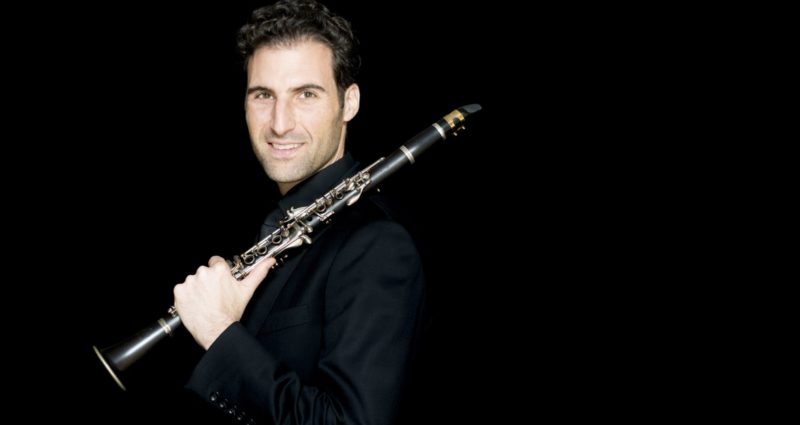
Michael Wayne, clarinet • Elinor Freer, piano
SERGEI PROKOFIEV (1891–1953)
Quintet in G Minor, Op. 39
Corinne Foley, oboe • Michael Wayne, clarinet • YooJin Jang, violin • Liz Freivogel, viola • Tracy Rowell, bass
JOHANNES BRAHMS (1833–1897)
Sonata in F Minor for Two Pianos, Op. 34b
Jon Nakamatsu, HieYon Choi, piano
Program Notes
ROBERT SCHUMANN
Fantasiestücke, Op. 73 (1849)
In early 1849, Robert Schumann began writing short chamber works for individual instruments with piano. According to a diary entry of his wife Clara Schumann, he aimed to write something for every member of the orchestra “one after the other.” He started with a collection of colorful Fantasiestücke (Fantasy Pieces) for Clarinet and Piano, Op. 73. By the end of the year, he had also completed a fanfare-filled Adagio and Allegro for Horn, Op. 70; five virtuosic Stücke im Volkston (Pieces in Folk Style) for Cello, Op. 102; and a set of three Romances for Oboe, Op. 94. He eventually wrote several violin sonatas and a volume of Märchenbilder (Fairy Tale Pieces) for Viola, but he never quite made it around to all the instruments of the symphony.
He published supplemental arrangements of all the shorter instrumental works he wrote in this sequence, inviting cellists and violinists to play the Fantasiestücke and the Adagio and Allegro, and violinists to try their hands at the Folk Pieces, the Oboe Romances, and the Märchenbilder. This was not simply done at the behest of his publisher for the practical reason of selling more copies. Rather, as musicologist Peter Szendy points out, Schumann had a general aesthetic interest in writing pieces that could be rightly realized by a multitude of instruments, since such a plurality of possible performers might move a work closer to an ideal form that wasn’t limited to a single medium.
In the Clarinet Fantasiestücke, Schumann includes a melancholy duet between clarinet and piano; a whimsical middle movement with a swaying, chromatically flirtatious Trio; and an explosive, joyous, fast Finale. He uses shared motifs to bind the three movements together. The melody of the first appears verbatim, only faster, as a riposte to the fiery main theme of the third, and the composer deploys the tune from the second movement in the Finale’s vertiginously accelerating Coda, creating a coherent, invigorating trajectory.
SERGEI PROKOFIEV
Quintet in G Minor, Op. 39 (1924)
In 1924, the choreographer Boris Romanov commissioned Sergei Prokofiev to compose a score for Trapèze, a new ballet about life in the circus. Prokofiev obliged Romanov’s request with music for oboe, clarinet, violin, viola, and double bass, and to make the most of the commission, he also devised it as a work that could be published independently. He released the six-movement quintet rendition in late 1924 as his Op. 39, before the ballet was produced, and since the ballet proved a flop, the chamber version is how this music has remained in the repertoire. We don’t know why Prokofiev chose to include a double bass. He did have some affection for the instrument, as is clear from works that showcase the bass like the film score to Lieutenant Kijé. But its inclusion here may have related to more practical concerns. The cello, the standard choice of low string instrument, requires a good chair, which can be a nuisance to bring on tour and to squeeze into flexible spaces where a small ballet company might perform. The double bass can be played standing, so despite its size, it sometimes makes more sense for traveling troupes.
This Quintet is one of Prokofiev’s most tonally and formally adventurous works. Still, though his harmonic language is dense and dissonant at times, he includes catchy melodic hooks and sprinkles the music with cadences, especially in the terse, opening theme and variation set. Many movements represent dances of the circus tumblers. The Allegro sostenuto has an infectious rhythmic scheme and calls for an aggressive technique in the violin, viola, and bass, which involves rapidly taking the bow off the string and then sharply reinitiating the sound many times in a row. The melody shared by clarinet and oboe at the start of the Allegro precipitato is a classic Prokofiev wrong-note tune, with lots of leaps and just enough slightly out-of-key pitches to keep the music peppery and fresh. In the final movement, the mood is more sober, as the crowd mourns the ballerina, who has suffered a harrowing accident.
JOHANNES BRAHMS
Sonata in F Minor for Two Pianos, Op. 34b (1862–64)
Johannes Brahms’s Piano Quintet in F minor, Op. 34, arrived at its final form by way of two false starts. He first wrote the music in 1862 as a string quintet with two cellos, the instrumentation that Franz Schubert had used for one of his magnificent late works. Brahms’s friends Clara Schumann and Joseph Joachim criticized its uneven textures and eventually convinced him that it was worth revising the scoring. In response, he turned the quintet into a Sonata for Two Pianos, Op. 34b, which he premiered with pianist Karl Tausig in April of 1864. Again, Schumann had objections, suggesting it should really be a work for full orchestra. Eventually, Brahms split the difference and made it a Quintet for Piano and Strings, which was well received by all parties.
The two-piano version is extremely successful in many regards. Brahms often shaped melodies and themes by concatenating small gestures that are seamlessly presented by different instruments. This can create an extraordinary sense of variety and development, but it also sometimes produces a certain blurriness that can leave one at a loss as to what to listen to. The secondary theme of the first movement of Brahms’s Piano Quintet is one such composite tune, in which little measure-long snippets of song are played by assorted members of the group. In the two-piano version, which has a relatively monochrome timbre, this theme’s continuity is brought into the foreground, and the music sings more clearly as a result.
There are other advantages to this sonata rendition. The slow movement lightly dances, chimes, and ponders in the manner of Brahms’s best piano miniatures. The manically triumphant, marching, multi-meter Scherzo benefits from the percussive power of the keyboard. The Finale opens with a searching Poco sostenuto in which the pealing contrapuntal entries emphasize the remarkable dissonances that Brahms included in the passage. The body of the movement is a diversion-filled, Hungarian-style dance that brims with energy until the very last measures and features an abrupt, angry ending that sounds like the protagonist of a play storming off stage in a huff at the close of an act.
Program Notes by Nicky Swett