

- This event has passed.
SOld out — join the waitlist
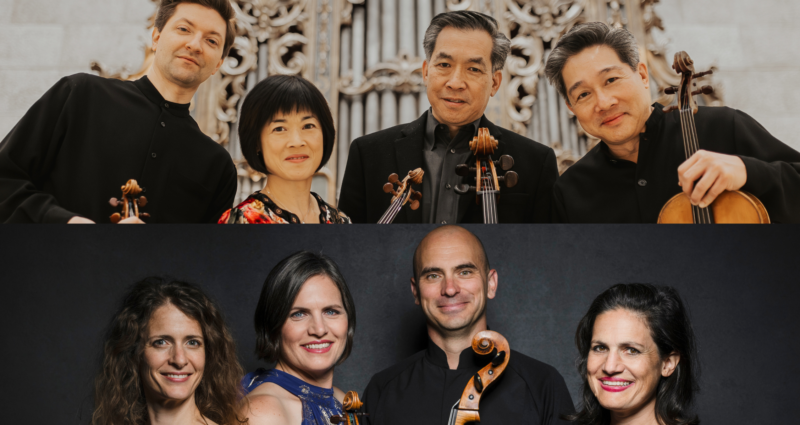
Jupiter & Ying Quartets
The Jupiter and Ying Quartets continue the Festival tradition of teaming up.
Jupiter String Quartet
Mélanie Clapiès, Meg Freivogel, violin • Liz Freivogel, viola • Daniel McDonough, cello
Ying Quartet
Robin Scott, Janet Ying, violin • Phillip Ying, viola • David Ying, cello
—
JOHANNES BRAHMS (1833–1897)
String Sextet No. 1 in B-flat Major, Op. 18
Mélanie Clapiès, Meg Freivogel, violin • Liz Freivogel, Phillip Ying, viola • Daniel McDonough, David Ying, cello
FELIX MENDELSSOHN (1809–1847)
Octet in E-flat Major, Op. 20
Robin Scott, Janet Ying, Mélanie Clapiès, Meg Freivogel, violin • Phillip Ying, Liz Freivogel, viola • David Ying, Daniel McDonough, cello
Program Notes
JOHANNES BRAHMS
String Sextet No. 1 in B-flat Major, Op. 18 (1859–1860)
Despite trying his hand at string quartets during the 1860s, the specter of Beethoven’s quartets continued to loom over the genre. Brahms would not feel satisfied with his attempts until 1873, when he was nearly 40. String quintets, meanwhile, were the province of Mozart (in two viola configuration) and Schubert (in two cello configuration), and Brahms’s early attempts to compose string quintets would prove even more frustrating: his first essay in that genre was eventually reworked as his Piano Quintet, and he would not venture another string quintet until the 1880s.
However, in contrast to quartets and quintets, the string sextet offered unfamiliar ground, with few precedents since the sextets of Luigi Boccherini over half a century prior. Young Brahms, exceedingly conscious of music history and anxious about his place in it, felt more confident experimenting with the larger, less trodden ensemble. He composed this first example at the age of 27, and a second one five years later. His success in these pieces can be measured by the litany of composers — including Dvořák, Dohnányi, Schoenberg, Schulhoff, and Strauss, among others — who, undaunted, took up the form in turn.
The scope of the composition is vast. Brahms spins no end of new melodies, including a theme in the style of a Viennese waltz which returns, in quiet pizzicato, to conclude the first movement. The second movement is a magisterial set of variations on a dolorous theme, introduced first in the lower strings, and then echoed with heightened intensity by the first violin. The third movement, a Scherzo, shows Brahms’s craft in displacing the strong beats of the meter, while in the buoyant Trio (the middle section of the Scherzo), he instead displaces the tonal center from one phrase to the next. And in the Rondo finale, Brahms pits various subdivisions of the ensemble against each other, introducing the main theme in the lower trio of instruments, after which the upper trio are allowed to respond.
FELIX MENDELSSOHN
Octet in E-flat Major, Op. 20 (1825)
Even if we disregard the age of the composer, Mendelssohn’s Octet stands as an astounding achievement. Haydn, as the tale goes, clung to string quartets since he “could not find the fifth part;” Mozart “found” the fifth part in his late quintets, but did not venture further; and Louis Spohr, whose first octets were published during the same decade as Mendelssohn’s, conceived of his as “double quartets” — performing antiphonally — rather than as a unified ensemble. Mendelssohn, however, composed for eight irreducible voices, expanding possibilities of counterpoint, texture, and interplay, allowing an orchestral richness of sound to enter the intimate habitat of chamber music. The novelty of the ensemble is demonstrated in Mendelssohn’s note to performers: “It is to be played in symphonic style by all the instruments; the pianos and fortes must be very precisely differentiated and be more strongly emphasized than usual.” And the innovations of the Octet are not limited to instrumentation: listen for the return of the Scherzo in the Finale, superimposed against the unison theme, in what is one of Mendelssohn’s first experiments with cyclical form.
These feats are all the more extraordinary in light of the fact that Mendelssohn composed the Octet at the age of sixteen. Mendelssohn’s childhood precocity, most frequently on display at the weekly musicales held in his family home, invited no shortage of attention, with frequent, inevitable comparisons between Mendelssohn and another young virtuoso from the previous century. When Goethe, who had heard seventeen-year-old Mozart play, went to hear Mendelssohn at age twelve, he wrote that “Mendelssohn bears the same relation to the Mozart of that time that the cultivated talk of a grown-up person bears to the prattle of a child.”
The Octet remained, according to Mendelssohn, “My favorite of all my compositions.” He would frequently participate in performances of it, usually playing viola, and would also orchestrate the Scherzo for concert settings. He later recalled, “I had a most wonderful time writing it;” his enjoyment is contagious, as the whirlwind of thematic interplay among the eight instrumentalists makes the Octet among the most delightful treats in the repertoire for musicians to perform and thrilling for audiences to witness.
Program Notes by Peter Asimov