

- This event has passed.
sOLD OUT — JOIN THE WAITLIST
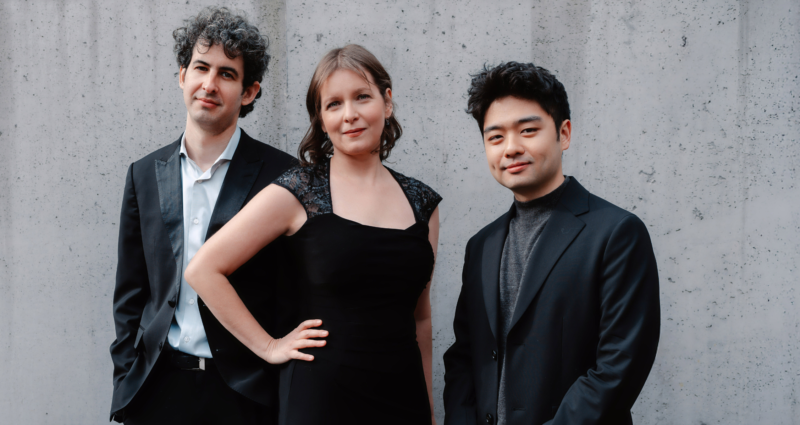
Lysander Piano Trio
Lysander Piano Trio
Itamar Zorman, violin • James Kim, cello • Liza Stepanova, piano
ENRIQUE GRANADOS (1867–1916) [ARR. CASSADÓ]
Intermezzo from “Goyescas”
FRANZ JOSEPH HAYDN (1732–1809)
Piano Trio in G Major, Op. 82, No. 2, Hob. XV:25, “Rondo all’Ongarese”
JENNIFER HIGDON (b. 1962)
Color Through
ARNOLD SCHOENBERG (1874–1951) [ARR. STEUERMANN]
Verklärte Nacht, Op. 4
—
Program Notes
ENRIQUE GRANADOS [ARR. CASSADÓ]
Intermezzo from “Goyescas”
The artist Francisco Goya loved to paint the majos and majas of late-18th– and early-19th-century Spain — working class men and women who developed a distinctive subculture and sense of fashion that involved colorful, ornate jackets, sashes, fans, and headdresses. In the first decade of the 20th century, the Spanish composer Enrique Granados developed a fascination with Goya, his turbulent relationships with those around him, and his artworks. As Granados wrote to his friend Joaquín Malats, “That whitish pink of the cheeks, contrasting with the blend of black velvet; those subterranean creatures, hands of mother-of-pearl and jasmine resting on jet trinkets, have possessed me.”
Between 1909 and 1911, he composed his Goyescas, a collection of short yet substantial pieces for solo piano, each of which was inspired by a particular Goya painting. At turns jocular, devastatingly sad, and humorous, they were among the finest such keyboard works written since Franz Liszt published his final Année de pèlerinage (Year of Pilgrimage) in 1883. Goyescas was Granados’s first unqualified international success. After receiving encouragement from friends and colleagues, he took music from this piano suite and expanded it into a one-act opera of the same name. The dramatic Intermezzo follows the opera’s first scene, in which a majo and maja have decided to disrupt the love affair of an aristocratic woman and the captain of the royal guard in a scheme that ultimately has tragic consequences. After a dramatic, unison introduction, Granados writes a tune that wavers between melancholy and floating, carefree romance. The melody is supported by a strummed accompaniment that sounds, if anything, even more bouncy and bass-like when it is played on the keyboard in this arrangement for piano trio by the Spanish cellist Gaspar Cassadó. The portentous opening motif returns in the middle of the Intermezzo over a thunderous tremolo, which eventually gives way to a sweetly pastoral closing section filled with appealing grace notes.
FRANZ JOSEPH HAYDN
Piano Trio in G Major, Op. 82, No. 2, Hob. XV:25, “Rondo all’Ongarese”
Haydn undertook his first journey to England in 1791 as continental Europe’s most celebrated living composer. His schedule was packed with performances, royal visits, and abundant socialising — “If I wanted, I could dine out every day,” he reported — even as he still managed to compose six symphonies and an opera, among smaller-scale compositions. Haydn was also called upon to give keyboard lessons to prominent pupils. One such student was Rebecca Schroeter. Schroeter and Haydn fell deeply in love, with Haydn’s notebooks testifying to the intensity of their affair; when Haydn returned to London for a second visit in 1794, he stayed a short walk from her residence. It was on that visit that Haydn dedicated a set of three trios, Hob. XV:24–26, to Schroeter. Like all 45 of Haydn’s piano trios, the works in this set maintain ties to the genre of the accompanied keyboard sonata from which they emerged, featuring a virtuosic piano part, adorned and buttressed by the violin and cello.
The middle trio of the set has become a favorite in the repertoire. Perhaps this is due to its moniker, alluding to the rollicking Finale, which bore the title “Rondo, in the Gypsies stile” in the London first edition and later became “Rondo all’Ongarese” (Rondo in the Hungarian Style). The genre of “Hungarian-Gypsy” music became highly popular (and profitable) in Vienna around the turn of the nineteenth century. Musicologist Catherine Mayes has counted hundreds of examples of published music classed as Danses hongroises, Zingaresi, or Ungarische Nationaltänze, exemplifying musical qualities stereotypically associated with “Hungarian-Gypsy” musicians by the Viennese public. Haydn, who spent most of his career at the Esterházy residence in the Hungarian countryside, was exposed to the music of Hungary’s Romani populations who occasionally performed at the palace. He had already tried his hand at imitating the style in an 1788 string quartet, but it is in the effervescent rondo of this Trio that he gave it a full airing, as if to bring to England a musical snapshot from home.
JENNIFER HIGDON
Color Through
Can music reflect colors and can colors be reflected in music? I have always been fascinated with the connection between painting and music. In my composing, I often picture colors as if I were spreading them on a canvas, except I do so with melodies, harmonies and through the instruments themselves. The colors that I have chosen in both of the movement titles and in the music itself, reflect very different moods and energy levels, which I find fascinating, as it begs the question, can colors actually convey a mood? — Jennifer Higdon
ARNOLD SCHOENBERG [ARR. STEUERMANN]
Verklärte Nacht, Op. 4
Schoenberg was 25 when he composed his string sextet Verklärte Nacht, considered an epitome of the Austro-German late Romantic idiom. The music features dense and contrapuntal chromaticism, motivic development and manipulation, and prolonged periods of breathless tension. In light of Schoenberg’s future developments, it may be tempting to read Verklärte Nacht as a farewell to the lush tonality of the nineteenth century before Schoenberg’s expressionist and serial turns. However, it was not received, or conceived, in that way. Audiences initially reacted hostilely to its premiere in 1902: the harmonic language was still challenging, and it was perceived as too dramatic and complex for intimate chamber music. Nevertheless, Schoenberg stayed his course, pursuing the same compositional paths in the same maximalist spirit throughout his career. Reflecting on Verklärte Nacht in 1937, Schoenberg remarked: “[Often] I have heard this complaint: ‘If only he had continued to compose in this style!’ The answer I give is perhaps surprising. I say: ‘I have not discontinued composing in the same style and in the same way as at the very beginning. The difference is only that I do it better now than before; it is more concentrated, more mature.’” Indeed, Schoenberg saw not a break but a continuity between the counterpoint, texture, and development of Verklärte Nacht and the techniques of his later works.
The title of Verklärte Nacht came to Schoenberg from a poem by Richard Dehmel (1863–1920), published in his 1896 collection Weib und Welt (Women and the World) and reproduced in translation below. Schoenberg did not consider the work program music in the traditional sense, in that it does not portray action or drama, but rather is “limited to drawing nature and expressing human feelings.” Dehmel himself, who was present for the premiere, conveyed his impression to Schoenberg: “I had intended to follow the motives of my text in your composition, but soon forgot to do so, I was so enthralled by the music.”
Schoenberg’s student Eduard Steuermann made the present arrangement for piano trio in 1932 with the encouragement of the composer. Steuermann leaves most of the dramatic, rich violin and cello solos from the original sextet version in place. The contrasting presence of the piano brings out some of the germinating motifs and contrapuntal detail that Schoenberg felt was essential to the piece’s construction, and which form a meaningful continuity with his later works.
Transfigured Night
Two figures pass through the bare, cold grove;
the moon accompanies them, they gaze into it.
The moon races above some tall oaks;
No trace of a cloud filters the sky’s light,
into which the dark treetops stretch.
A female voice speaks:
I am carrying a child, and not yours;
I walk in sin beside you.
I have deeply sinned against myself.
I no longer believed in happiness
And yet was full of longing
For a life with meaning, for the joy
And duty of maternity; so I dared
And, quaking, let my sex
Be taken by a stranger,
And was blessed by it.
Now life has taken its revenge,
For now I have met you, yes you.
She takes an awkward step.
She looks up: the moon races alongside her.
Her dark glance is saturated with light.
A male voice speaks:
Let the child you have conceived
Be no trouble to your soul.
How brilliantly the universe shines!
It casts a luminosity on everything;
you float with me upon a cold sea,
but a peculiar warmth glimmers
from you to me, and then from me to you.
Thus is transfigured the child of another man;
You will bear it for me, as my own;
You have brought your luminosity to me,
You have made me a child myself.
He clasps her round her strong hips.
Their kisses mingle breath in the night air.
Two humans pass through the high, clear night.
Translation: Scott Horton.