

- This event has passed.
Ensemble Dal Niente
Ensemble Dal Niente
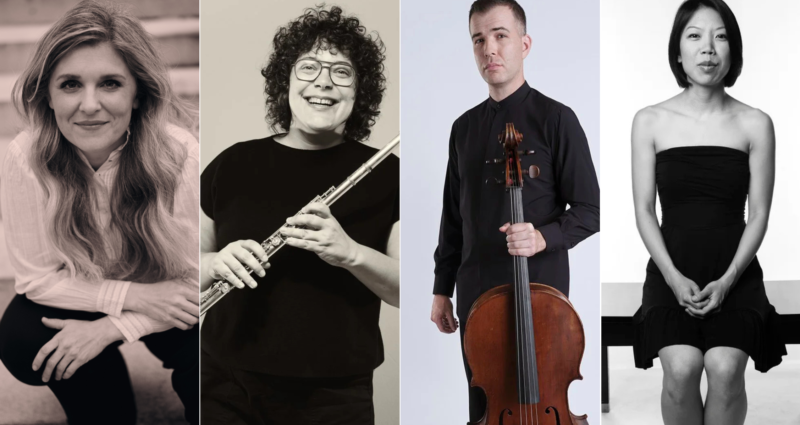
Amanda DeBoer Bartlett, soprano • Emma Hospelhorn, flute • Chris Wild, cello • Mabel Kwan, piano
KAIJA SAARIAHO (1952–2023)
Cendres
Emma Hospelhorn, flute • Chris Wild, cello • Mabel Kwan, piano
HILDA PAREDES (b. 1957)
Canciones sobre poemas de Eduardo Hurtado
Amanda DeBoer Bartlett, soprano • Mabel Kwan, piano
ANDILE KHUMALO (b. 1978)
IsO[r]
Emma Hospelhorn, flute • Chris Wild, cello • Mabel Kwan, piano
REBECCA SAUNDERS (b. 1967)
O Yes & I
Amanda DeBoer Bartlett, soprano • Emma Hospelhorn, bass flute
SALVATORE SCIARRINO (b. 1947)
Ultime Rose (da Vanitas)
Amanda DeBoer Bartlett, soprano • Chris Wild, cello • Mabel Kwan, piano
—
Program Notes
KAIJA SAARIAHO
Cendres (1998)
I found the basis of the musical material for this piece in my double concerto … à la fumée for alto flute, cello and orchestra. The name of the piece also derives from this.
While writing Cendres, I was mainly concentrating on the interpretation of particular musical ideas by the three different instruments of the trio, each of which has its unique character and palette of colours. Musical tension is created and regulated by sometimes bringing the instruments as close together as possible in all ways (pitch, rhythm, dynamics, articulation, colour etc.), or, at the other extreme, letting each of them express the music in their most idiomatic fashion. Between these two extremes there is an unlimited number of possible ways to create more or less homogenous musical situations. The consciousness of this variety was the rope on which I was balancing whilst working on the piece.
Cendres was commissioned by the Gesellschaft für Neue Musik Ruhr and Kulturbüro der Stadt Essen for the Wolpe Trio.
Program Note by Kaija Saariaho
HILDA PAREDES
Canciones sobre poemas de Eduardo Hurtado (1992)
I have found setting poetry to music a very enriching and enlightening experience, which always sparks off my imagination into directions I don’t necessarily go towards when I write instrumental music.
From the very first time I heard Eduardo Hurtado reading his poems in Mexico City in the early ’90s, I realized that in his poetry there was an invitation to create a world of sound. So I wrote this song cycle in ’92, at a time when I was living in Mexico.
Program Note by Hilda Paredes
ANDILE KHUMALO
IsO[r] (2004)
As an African, I am deeply committed to the belief that my work is an integral part of the contemporary African narrative, a story that I am resolute in telling. This narrative, with its multi-dimensional nature, has led me to adopt a hybrid approach to composition. My work is rooted in the idea that sound is the primary resource for composition. This concept is deeply influenced by my training in acoustics, particularly the French spectral school, and my study of Nguni spectral music, a field that we can hear in the music of the amaXhosa people of South Africa.
As a young boy, I was captivated by the world of painting, particularly the power of color and shape. This fascination has become a vital part of my musical world, which is centered around timbre. The interplay of different perspectives on the same object, and how they can create varied meanings based on the object’s position and the environment, is another intriguing aspect of my work.
The works of the Swiss artist Markus Raetz have been instrumental in shaping my approach to music. In IsO[r], the piano’s timbre forms the foundation from which the rest of the musical objects are developed.
Program Note by Andile Khumalo
REBECCA SAUNDERS
O Yes & I (2017–18)
Rebecca Saunders wrote O Yes & I for soprano and bass flute in 2018. It was part of a cycle of vocal works inspired by the closing chapter of James Joyce’s Ulysses, in which the protagonist’s wife, Molly Bloom, delivers an improvisatory, punctuation-less monologue. Saunders combines bits of Joyce with her own fragmentary statements and puts all this text through a singular sonic filter. The bass flute acts as an extender of the soprano’s dynamically extreme vocal acrobatics, taking sung gestures and augmenting them with sounds that humans cannot produce. Together, the voice and flute form a single, composite instrument capable of gasping, speaking, trilling, fluttering, and traversing an astonishing range. As the composer describes the piece, “Words or phrases rear up, becoming visible, audible, and intelligible, before disappearing again, consumed within the flow of the music—just as moments of Bloom’s biography, personality, and memories take on temporary form in her stream-of-consciousness monologue, only to sink back into the river of time.”
SALVATORE SCIARRINO
Ultime Rose (da Vanitas) (1981)
Vanitas (Vanity), Salvatore Sciarrino’s chamber cantata for voice, cello, and piano, dates from 1981. In a detailed, philosophical program note on the work, he claims that the title came to him in a dream and that it refers to the “concept of emptiness and its representation, and the concept of time.” “Flowers are the true protagonists of Vanitas,” he explains, writing that flowers, like songs, have an ephemeral, fleeting beauty that reflects back to us the awe-inspiring truth that our time on this earth is limited.
Ultime Rose (Final Rose) is the last of the work’s five movements. In it, the three instruments mostly serve separate functions. The singer starts alone with a mesmerizing, keening soliloquy and ends most phrases by wavering on a few grace notes and then letting the voice dip down to silence. The cello’s fragile harmonics create ethereal countermelodies that occasionally interact with the singer for bits of haunting dialogue. The piano just plays chords, which are sometimes aggressively short and sometimes sustained like the sound of a resonant bell. The harmonies eventually become sweeter — even a bit jazzy at points — cautiously dipping into what Sciarrino saw as the deceptively deep realm of popular song.
Program Notes by Nicky Swett
Ensemble Dal Niente performs, develops, and sustains new and experimental music for small to large chamber ensemble. We are dedicated to growing relationships with artists, composers, and listeners; advancing distinct and challenging musical voices; and sharing that work with our Chicago, U.S., and international communities.
Dal Niente’s roster of 27 musicians presents an uncommonly broad range of contemporary music. Audiences coming to Dal Niente shows can expect distinctive productions—from fully staged operas to multimedia spectacles to intimate solo performances— that are curated to pique curiosity and connect art, culture, and people.
Since 2004, Ensemble Dal Niente has performed concerts across Europe and the Americas, including appearances at The Metropolitan Museum of Art in NYC; The Foro Internacional de Música Nueva in Mexico City; Radialsystem Berlin, MusicArte Festival in Panama City; The Library of Congress and the Phillips Collection in Washington, D.C.; the Art Institute of Chicago and the Hyde Park Jazz Festival; Walt Disney Concert Hall in Los Angeles; Big Ears Music Festival; The Americas Society; and the Darmstadt Summer Courses in Germany. Dal Niente is the recipient of the 2019 Fromm Music Foundation prize, and was the first-ever ensemble to win the Kranichstein prize for interpretation in 2012. The group has recordings available on the New World, New Amsterdam, New Focus, Navona, Parlour Tapes+, and Carrier labels; has held residencies at The University of Chicago, Harvard University, Stanford University, Brown University, Brandeis University, and Northwestern University, among others; and collaborated with a wide range of composers, from Enno Poppe to George Lewis to Hilda Paredes to Roscoe Mitchell.
The ensemble’s name, Dal Niente (“from nothing” in Italian), is a tribute to Helmut Lachenmann’s Dal niente (Interieur III), a work that upended traditional conceptions of instrumental technique; and also a reference to the group’s humble beginnings.